Introduction
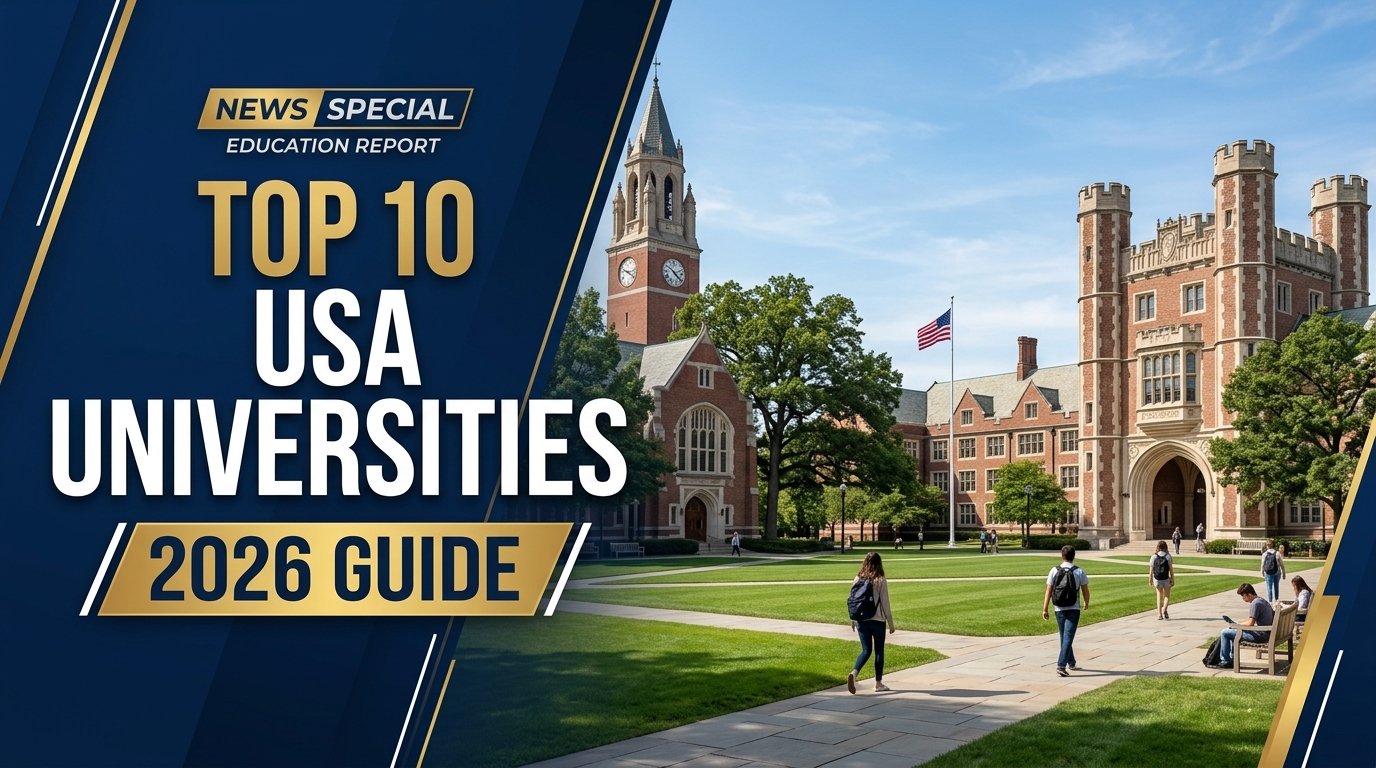
The United States is one of the world’s most popular destinations for higher education. Every year, students from different countries apply to American universities to pursue degrees in computer science, engineering, business, medicine, economics, law, and many other fields.
Some of the best-known institutions include the Massachusetts Institute of Technology (MIT), Harvard University, Stanford University, Princeton University, and the California Institute of Technology (Caltech). These universities are recognized for their academic standards, research facilities, experienced faculty, and opportunities for students to develop professional skills.
According to the QS World University Rankings 2027, MIT remains the world’s number-one university, while Stanford University and Harvard University are also among the global leaders. In the latest U.S. News national university rankings for 2026–27, MIT has taken the top position in the United States. Rankings differ because organizations use different evaluation methods.
For students planning to study abroad, choosing a university involves more than looking at its ranking. Tuition fees, scholarships, location, admission requirements, and available degree programs also matter.
This guide explores ten leading universities in the USA, their strengths, popular study options, and important considerations for prospective students.
Top 10 Universities in the USA
The following list highlights ten prestigious American institutions. It is a practical selection, not a single official ranking from 1 to 10, because university positions change depending on the ranking organization and subject.
| University | Location | Known for |
|---|---|---|
| 1. Massachusetts Institute of Technology (MIT) | Cambridge, Massachusetts | Engineering, AI, technology |
| 2. Stanford University | Stanford, California | Computer science, entrepreneurship |
| 3. Harvard University | Cambridge, Massachusetts | Business, law, medicine |
| 4. California Institute of Technology (Caltech) | Pasadena, California | Physics, science, engineering |
| 5. Princeton University | Princeton, New Jersey | Mathematics, economics, research |
| 6. University of California, Berkeley | Berkeley, California | Engineering, computer science |
| 7. Yale University | New Haven, Connecticut | Law, humanities, social sciences |
| 8. University of Chicago | Chicago, Illinois | Economics, social sciences |
| 9. University of Pennsylvania | Philadelphia, Pennsylvania | Business, finance, healthcare |
| 10. Cornell University | Ithaca, New York | Engineering, business, sciences |
The universities listed above are recognized internationally, although their exact positions vary across global rankings and subject-specific tables.
1. Massachusetts Institute of Technology (MIT)

MIT is one of the most prestigious universities in the United States, particularly for students interested in science, technology, engineering, mathematics, and innovation. Located in Cambridge, Massachusetts, MIT has built a strong reputation for combining theoretical learning with practical research.
The university offers programs in computer science, electrical engineering, mechanical engineering, economics, mathematics, physics, artificial intelligence, and other fields. Its research environment attracts students who want to solve real-world problems and develop new technologies.
MIT is especially attractive to aspiring software engineers, scientists, researchers, and technology entrepreneurs. Students can benefit from research laboratories, collaborative projects, and connections with the wider technology ecosystem around Boston.
However, admission is highly competitive. Applicants should prepare a strong academic record, demonstrate intellectual curiosity, and carefully review the requirements for their intended degree.
Best for: Engineering, computer science, AI, physics, and technology research.
Official website: mit.edu
2. Stanford University

Stanford University is located in California’s Silicon Valley region, an area associated with technology companies, startups, and entrepreneurship. Its location makes it an attractive choice for students interested in innovation, business, computer science, and engineering.
Stanford offers undergraduate and graduate programs across engineering, humanities, medicine, law, education, and business. Students interested in artificial intelligence, software development, robotics, or technology startups often consider Stanford because of its research culture and entrepreneurial environment.
The university also provides opportunities for interdisciplinary study, allowing students to combine interests in technology, business, and social sciences.
Like MIT, Stanford has an extremely selective admissions process. Strong grades alone may not guarantee admission, so applicants should present a thoughtful application that reflects their interests, achievements, and potential contributions to the university community.
Best for: Computer science, entrepreneurship, engineering, and innovation.
Official website: stanford.edu
3. Harvard University

Harvard University is one of the most recognized names in higher education. Founded in 1636, it is located in Cambridge, Massachusetts, and is known for its academic tradition, research resources, and extensive alumni network.
Harvard offers education in a wide range of fields, including business, law, medicine, public policy, economics, biological sciences, and the humanities. Its graduate schools are particularly prominent, while undergraduate students can explore different academic disciplines before deciding on a specific concentration.
Students who want careers in research, government, business, healthcare, or public service may find Harvard’s academic environment appealing. Its alumni community and professional connections can also be valuable throughout a student’s career.
Nevertheless, Harvard is highly selective and can be expensive without financial assistance. Applicants should investigate the university’s official financial aid policies rather than assuming that all students must pay the full published price.
Best for: Business, law, medicine, economics, and interdisciplinary education.
Official website: harvard.edu
4. California Institute of Technology (Caltech)

Caltech is a relatively small research university with a major international reputation in science and engineering. It is located in Pasadena, California, and is known for its rigorous academic environment and emphasis on scientific discovery.
The university is particularly suitable for students interested in physics, chemistry, astronomy, mathematics, computing, and engineering. Its smaller scale can appeal to students who prefer an intensive academic setting focused on research and collaboration.
Caltech’s scientific work spans areas such as space exploration, climate science, fundamental physics, and advanced engineering. Students who enjoy mathematics, experimentation, and solving complex technical problems may find its academic approach rewarding.
Because the institution is small and selective, gaining admission can be difficult. Prospective applicants should examine course prerequisites, application requirements, and available financial support before applying.
Best for: Physics, astronomy, mathematics, chemistry, and engineering.
Official website: caltech.edu
5. Princeton University

Princeton University is a leading private research university in New Jersey. It is known for strong undergraduate teaching, rigorous academics, and research opportunities in numerous disciplines.
Its academic strengths include mathematics, economics, public policy, physics, computer science, politics, and the humanities. Princeton can be an excellent option for students who want a strong academic foundation and close engagement with faculty.
The university also emphasizes independent research and, in many undergraduate programs, substantial individual academic projects. These opportunities can help students develop critical thinking, research skills, and the ability to communicate complex ideas.
Applicants should review Princeton’s undergraduate and graduate admissions processes separately, as their requirements differ. Financial aid availability and eligibility should also be checked directly with the university.
Best for: Mathematics, economics, public policy, physics, and undergraduate research.
Official website: princeton.edu
6. University of California, Berkeley

The University of California, Berkeley, is a major public research university in California. It is widely known for its academic programs, research activity, and contributions to science, technology, and public policy.
Berkeley is particularly attractive to students interested in computer science, engineering, data science, chemistry, economics, environmental studies, and mathematics. Its large campus offers a broad selection of courses and research opportunities.
Unlike many private universities, Berkeley is part of a public university system. However, international students should not assume that public universities are automatically inexpensive: nonresident tuition and living expenses can be substantial.
The university’s location near the San Francisco Bay Area may provide access to professional networks, research organizations, and technology-related opportunities, depending on a student’s program and experience.
Best for: Engineering, computer science, data science, and environmental studies.
Official website: berkeley.edu
7. Yale University

Yale University, located in New Haven, Connecticut, is a prestigious private university known for its academic breadth and historic campus.
Its programs span the humanities, social sciences, biological sciences, arts, economics, political science, and many professional fields. Yale is especially attractive to students who want to explore multiple disciplines while developing a strong academic specialization.
The university also has well-known graduate and professional schools, including its law and medical schools. Students considering these careers should remember that professional degrees often have separate admissions processes and additional prerequisites.
Yale’s selective admissions process means applicants should prepare carefully, including academic records, recommendations, essays, and any required standardized testing or English-language documentation.
Best for: Law, humanities, political science, arts, and social sciences.
Official website: yale.edu
8. University of Chicago

The University of Chicago is known for its analytical academic culture and contributions to economics, social sciences, mathematics, and fundamental research.
Located in Chicago, Illinois, the university offers programs in areas including economics, business, public policy, physics, biological sciences, computer science, and the humanities.
Its educational environment is often associated with intensive reading, critical discussion, quantitative analysis, and rigorous examination of ideas. Students who enjoy debating complex questions and working through challenging academic material may find it a good fit.
The university’s professional schools and research centers also provide opportunities for advanced study. Applicants should compare individual programs because admission standards, costs, and career pathways differ by department.
Best for: Economics, social sciences, public policy, mathematics, and research.
Official website: uchicago.edu
9. University of Pennsylvania (UPenn)

The University of Pennsylvania, commonly called UPenn, is an Ivy League university in Philadelphia, Pennsylvania. It offers a broad range of academic programs and is particularly well known for business, finance, healthcare, and interdisciplinary education.
Its Wharton School is a prominent choice for students interested in business administration, finance, management, and entrepreneurship. UPenn also offers programs in engineering, nursing, arts and sciences, education, and other fields.
Students interested in connecting academic study with professional practice may appreciate the university’s range of schools and research opportunities. However, applicants should choose a degree based on their academic interests and career goals, not solely on the institution’s reputation.
As with other leading private universities, tuition and living costs should be considered alongside scholarships and financial aid.
Best for: Business, finance, healthcare, engineering, and management.
Official website: upenn.edu
10. Cornell University

Cornell University is an Ivy League research university located in Ithaca, New York. It offers a diverse academic environment, with programs covering engineering, computer science, business, agriculture, life sciences, architecture, and hospitality management.
One of Cornell’s advantages is the breadth of its academic offerings. Students can explore technical subjects, scientific research, applied professional education, and the humanities within one university.
Cornell may be a particularly interesting option for students who want to study engineering, computer science, business, biological sciences, or interdisciplinary fields. Its research facilities and academic departments provide opportunities for students to develop both theoretical knowledge and practical skills.
Applicants should check the specific college or school offering their intended major because requirements and costs can differ across programs.
Best for: Engineering, computer science, business, life sciences, and hospitality.
Official website: cornell.edu
How Much Does It Cost to Study at a Top University in the USA?
One of the most important questions for international students is the total cost of studying in America. Tuition fees vary significantly depending on the university, degree level, academic program, and financial aid package.
Private universities generally have high published tuition prices, while public universities may charge different rates for in-state, out-of-state, and international students.
| Expense | Approximate annual cost in USD |
|---|---|
| Undergraduate tuition | $25,000–$70,000+ |
| Accommodation and food | $12,000–$25,000 |
| Books and study materials | $500–$2,000 |
| Health insurance and personal expenses | $2,000–$6,000 |
| Estimated total | $40,000–$100,000+ |
These are broad planning estimates, not the official fees of any particular university. Actual costs may fall outside these ranges, especially for specialized programs and high-cost locations.
Before applying, students should check the university’s official cost-of-attendance page. Graduate programs, especially business and medicine, may have substantially different fees from undergraduate degrees.
Students should also distinguish between tuition and the total cost of attendance. Even when tuition is affordable, accommodation, food, transportation, insurance, and other living expenses can increase the overall budget.
Admission Requirements for International Students
Admission requirements vary by university and degree level. However, many American universities ask international applicants to prepare the following documents.
- Academic transcripts: School or university records showing previous academic performance.
- Educational qualifications: A high school diploma for undergraduate study or an appropriate previous degree for graduate programs.
- English-language proficiency: IELTS, TOEFL, or another accepted qualification when required by the institution.
- Standardized tests: SAT, ACT, GRE, or GMAT scores where applicable. Requirements vary by university and program.
- Personal essays: Some universities request statements explaining an applicant’s interests, achievements, and educational goals.
- Recommendation letters: Academic or professional references, depending on the program.
- Financial documentation: Evidence of funding may be needed for the university’s documentation and the student visa process.
Applicants should always consult the official admissions page for their chosen university. Requirements can change between application cycles, and not every university requires every document.
Scholarships for International Students in the USA
The cost of American higher education can be challenging, but financial support may be available to eligible international students.
1. Need-based financial aid
Some universities offer financial assistance based on a student’s demonstrated financial circumstances. Eligibility rules and policies for international applicants differ by institution.
2. Merit-based scholarships
Merit scholarships may reward academic achievement, leadership, research, artistic ability, or other accomplishments. Some are automatic considerations, while others require separate applications.
3. Graduate research assistantships
Students pursuing research-based master’s or doctoral degrees may find assistantships that provide a stipend, tuition support, or both. Availability depends on the department, research funding, and the student’s qualifications.
4. External scholarships
Government-funded programs, charitable organizations, and other scholarship providers may support eligible students studying in the United States.
Important tip: Do not assume that every highly ranked university provides a full scholarship to every admitted international student. Check eligibility, deadlines, renewal conditions, and the amount of financial support before making a decision.
How to Choose the Best University in the USA
Choosing the right university requires more than comparing rankings. A university that is excellent for computer science may not be the best fit for someone pursuing literature, nursing, or public policy.
Consider these five factors before applying:
- Your intended major: Check the quality, curriculum, and research opportunities of the specific department.
- Your budget: Calculate tuition, living costs, insurance, travel, and available financial assistance.
- Admission chances: Review the university’s published requirements and prepare a realistic list of ambitious, target, and alternative options.
- Location and campus environment: Consider climate, transportation, housing, student services, and proximity to relevant industries.
- Career opportunities: Investigate internships, alumni networks, career support, and the employment opportunities associated with your chosen field.
It is also useful to compare more than one university before submitting applications. A well-matched institution with strong financial support may be a better choice than a more famous university that does not fit your goals.
Frequently Asked Questions (FAQs)
Which is the number one university in the USA in 2026?
MIT holds the top position in the U.S. News 2026–27 national university rankings and also ranks first globally in the QS World University Rankings 2027. Rankings can differ depending on the organization and its methodology.
Is Harvard better than MIT?
Neither university is universally better. MIT is particularly strong in engineering, computing, and technology, while Harvard offers extensive options in areas such as business, law, medicine, and the humanities. The best choice depends on the student’s intended subject and career plans.
Can international students get scholarships in the USA?
Yes. Some universities offer need-based financial aid or merit scholarships to eligible international students. Graduate students may also find funded research opportunities, although eligibility and funding levels vary.
What GPA is required for top universities in the USA?
There is no single GPA requirement that applies to all leading universities. Competitive applicants generally have strong academic records, but admissions decisions may also consider essays, recommendations, extracurricular achievements, and program-specific criteria.
Are public universities in the USA cheaper than private universities?
They can be, but not always for international students. Public universities may charge higher nonresident tuition, so students should compare the full published cost of attendance and any financial aid available.
Conclusion
The United States offers a wide range of outstanding universities for students pursuing careers in technology, science, business, medicine, law, and many other disciplines. MIT, Stanford, Harvard, Caltech, Princeton, Berkeley, Yale, the University of Chicago, UPenn, and Cornell each have distinct strengths.
The smartest way to choose among the top universities in the USA is to consider academic quality alongside tuition costs, financial aid, admission requirements, location, and career goals.
Students who start preparing early, research programs carefully, and submit complete applications can make more informed decisions about their future education. Before committing to a university, always verify the latest admissions deadlines, tuition figures, and scholarship policies through official university websites.
Blog Thumbnail Prompt for BBGnews.com
