
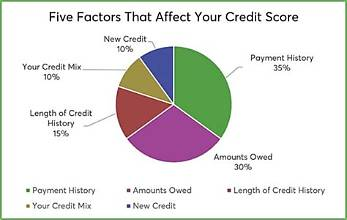
Understanding your FICO credit score is an important part of managing your finances in the United States. A FICO Score is a three-digit number calculated from information in your credit reports to help lenders evaluate how likely you are to repay borrowed money. It is based on five main factors: payment history, amounts owed, length of credit history, new credit, and credit mix. Each factor has a different level of influence on the calculation. Understanding these five components can help you make sense of your credit profile, recognize what lenders evaluate, and learn how everyday financial habits relate to creditworthiness.
What Is a FICO Credit Score?
A FICO Score is a credit score developed by Fair Isaac Corporation (FICO). It uses information in consumer credit reports to estimate the risk associated with lending money to an individual.
In the United States, lenders may use FICO Scores when evaluating applications for credit cards, mortgages, auto loans, and other forms of borrowing. A person’s credit score may influence whether an application is approved and what borrowing terms are offered.
Most commonly used base FICO Scores range from 300 to 850. Generally, a higher score indicates a lower estimated risk of missing credit payments, while a lower score may indicate a higher estimated risk.
However, a FICO Score does not measure someone’s overall financial health, income, savings, or personal character. It focuses primarily on information about credit behavior.
FICO Scores are calculated using information supplied by the three major credit reporting companies:
- Equifax
- Experian
- TransUnion
These companies collect information about consumer credit accounts and payment activity. FICO uses the available information to calculate scores through its scoring models.
It is important to understand that there is no single credit score that remains identical everywhere. Different scoring models, credit reporting agencies, and reporting dates can produce different results.
How Do FICO Credit Scores Work? Understanding the Five Factors
FICO Scores consider five main categories of credit information. Each category has an approximate percentage weight in the widely discussed base scoring framework.
The general breakdown is:
| Credit score factor | Approximate weight |
|---|---|
| Payment history | 35% |
| Amounts owed | 30% |
| Length of credit history | 15% |
| New credit | 10% |
| Credit mix | 10% |
These percentages describe the relative importance of each category, not a simple formula that calculates a person’s final score. FICO scoring models evaluate multiple details within each category, and the impact of individual information depends on the complete credit profile.
Let’s examine each factor.
1. Payment History: Approximately 35%
Payment history is generally the most influential factor in a FICO Score. It reflects how consistently someone has paid their credit obligations according to the agreed terms.
Lenders and scoring models may consider information such as:
- Whether payments were made on time.
- How frequently payments were missed.
- How late a payment was.
- How recently a missed payment occurred.
- Whether an account was sent to collections.
- Whether a bankruptcy or other serious negative event appears in the credit report.
A consistent record of on-time payments generally demonstrates responsible credit management. On the other hand, late payments and other negative credit events can affect a score.
The severity, frequency, and recency of negative information can influence how significant its impact becomes.
For example, a single missed payment may be evaluated differently from a pattern of repeated late payments. Recent negative activity may also matter more than older information.
Hypothetical Example 1: Payment History
Imagine two individuals who each have a credit card and an auto loan.
- Person A consistently makes payments by their due dates.
- Person B frequently misses payment deadlines and has several reported late payments.
Even if both individuals have similar incomes and outstanding balances, their credit reports show different repayment histories.
The scoring model may interpret Person A’s history as evidence of more consistent repayment behavior. Person B’s missed payments may represent a greater lending risk.
This example is illustrative only. Actual score differences depend on the complete credit report and scoring model.
2. Amounts Owed: Approximately 30%
The second major factor is the amount of debt reflected in a person’s credit reports.
FICO considers more than the total amount of money someone owes. It also evaluates how much available revolving credit is being used and how balances relate to original loan amounts.
One important concept within this category is credit utilization.
Credit utilization measures the percentage of available revolving credit currently being used.
For example, suppose someone has a credit card with a $10,000 limit and a $3,000 balance. Their utilization ratio is 30%.
The calculation is:
\[ \frac{\$3,000}{\$10,000}\times100=30\% \]
Credit utilization provides information about how heavily someone relies on available revolving credit.
Generally, lower revolving balances relative to available limits are viewed more favorably by many scoring models. High utilization can indicate that someone is relying heavily on borrowed money.
FICO may also consider:
- Total outstanding debt.
- Balances across individual credit accounts.
- The number of accounts carrying balances.
- Remaining balances on installment loans.
- The relationship between balances and original loan amounts.
Hypothetical Example 2: Credit Utilization
Imagine someone has two credit cards:
- Credit Card A has a $5,000 limit and a $1,000 balance.
- Credit Card B has a $5,000 limit and a $4,000 balance.
Their combined available credit is $10,000, while their total outstanding balance is $5,000.
Their overall utilization is 50%.
If the reported balances change, the utilization ratio may also change. This can affect the information considered by a FICO scoring model.
The example illustrates why outstanding balances and available credit matter when evaluating creditworthiness.
3. Length of Credit History: Approximately 15%
The length of credit history measures how long someone has been using credit and how established their accounts are.
A longer history can provide more information about a person’s borrowing and repayment behavior.
FICO may consider several details within this category, including:
- The age of the oldest credit account.
- The age of the newest credit account.
- The average age of all accounts.
- How long different account types have been established.
- How recently certain accounts have been used.
Someone who has responsibly managed credit for many years may have a more established credit profile than someone who recently opened their first account.
However, a short credit history does not automatically mean someone has poor credit. It simply means the scoring model has less historical information available.
Closing an older credit card can sometimes affect the credit profile over time, depending on how the account is reported and how the scoring model evaluates the remaining accounts.
This is one reason credit history should be understood as a long-term component rather than something that changes entirely because of one month’s activity.
Building credit history generally takes time, and there is no instant method of creating several years of responsible repayment records.
4. New Credit: Approximately 10%
The fourth factor considers recent applications for credit and newly opened accounts.
When someone applies for a credit card, personal loan, mortgage, or another credit product, the lender may request their credit report. This process can create a hard inquiry.
A hard inquiry indicates that a lender reviewed a consumer’s credit information in connection with a credit application.
FICO may consider:
- The number of recently opened accounts.
- The number of recent hard inquiries.
- How recently new accounts were opened.
- The time since the most recent credit application.
- The overall pattern of recent credit activity.
Applying for several credit accounts within a short period may indicate increased borrowing activity. Depending on the person’s existing credit history, this can negatively affect a FICO Score.
However, not every credit inquiry affects a score.
For example, checking your own credit report or score is generally considered a soft inquiry and does not lower your FICO Score.
Some scoring models also recognize rate shopping. Multiple inquiries for certain types of loans, such as mortgages or auto loans, may be treated as a single inquiry when they occur within a specified shopping period. The applicable period depends on the scoring model.
Understanding this distinction helps explain why reviewing your own credit information is different from submitting multiple credit applications.
5. Credit Mix: Approximately 10%
Credit mix refers to the different types of credit accounts appearing in a person’s credit history.
FICO considers whether someone has experience managing different forms of borrowing.
Common account types include:
- Revolving credit: Credit cards and retail credit accounts that allow balances to be carried over.
- Installment loans: Loans repaid through scheduled payments, such as auto loans and student loans.
- Mortgage loans: Loans used to finance residential property.
- Other credit accounts: Certain finance company accounts and additional credit arrangements.
Having experience with different account types may provide more information about someone’s ability to manage credit obligations.
However, credit mix does not mean that everyone needs a mortgage, auto loan, and several credit cards to establish a strong credit profile.
It represents only one part of the overall scoring calculation. A person’s payment history and amounts owed generally carry considerably more weight.
Opening unnecessary credit accounts simply to diversify a credit profile may create additional financial obligations without providing meaningful benefits.
What Can Cause Your FICO Score to Change?
A FICO Score is not a permanent number. It can change as information in a credit report is updated.
Creditors regularly report account information to credit reporting companies. When new information becomes available, the scoring model may calculate a different result.
Several events can contribute to changes:
- A newly reported payment.
- A missed or late payment.
- A change in credit card balances.
- Opening a new credit account.
- Paying down an existing loan.
- A hard inquiry resulting from a credit application.
- Negative information being added or removed from a credit report.
The timing of these changes depends on when creditors report information and when a particular score is calculated.
For instance, paying down a credit card balance may not immediately change every credit score because the updated balance must first appear in the relevant credit report.
Similarly, an older negative item becoming less influential does not guarantee a specific score increase.
Understanding these factors helps explain why credit scores can vary even when someone’s overall financial circumstances have not changed significantly.
FICO Scores vs. Other Credit Scores: Why Are They Different?
FICO is not the only company or organization that calculates credit scores. Another widely recognized scoring system in the United States is VantageScore.
Both systems use information from consumer credit reports to estimate credit risk. However, they use different scoring formulas and may evaluate certain information differently.
As a result, a consumer may see different scores depending on the scoring model being used.
There are several reasons for these differences:
- Different scoring models: FICO and VantageScore use separate mathematical formulas.
- Different credit reports: Equifax, Experian, and TransUnion may have different information about the same consumer.
- Different reporting dates: A balance or payment may have been updated by one credit bureau but not another.
- Different score versions: FICO has multiple scoring models designed for different lending situations.
For example, a mortgage lender may use a different FICO version from a credit card lender. This means a score obtained from one source may not match the score used during a particular loan application.
A difference between two credit scores does not necessarily mean that one is incorrect. It may simply reflect differences in the underlying information or scoring methodology.
How to Understand and Monitor Your Credit Report
Understanding a FICO Score also involves understanding the credit report behind it.
A credit report contains information about credit accounts, payment activity, outstanding balances, and certain public-record or collection information.
Reviewing these reports can help consumers identify inaccurate information and understand what lenders may see when evaluating a credit application.
The three major credit reporting companies are Equifax, Experian, and TransUnion.
Consumers can obtain their credit reports through the federally authorized AnnualCreditReport.com website.
When reviewing a report, pay attention to:
- Personal information: Check whether your name, address, and other identifying details are accurate.
- Account information: Confirm that listed credit cards and loans belong to you.
- Payment records: Review whether payment statuses and dates are correctly reported.
- Outstanding balances: Check whether reported balances appear accurate.
- Hard inquiries: Identify credit applications you recognize and investigate unfamiliar inquiries.
- Collection accounts: Review whether any listed collection debts are accurate.
If information appears incorrect, consumers generally have the right to dispute inaccurate or incomplete information with the credit reporting company and, where appropriate, the company that supplied it.
It is important to distinguish between an inaccurate entry and legitimate negative information. A credit reporting company is not required to remove accurate information simply because it negatively affects a credit score.
Regularly reviewing credit reports provides a clearer picture of personal credit history and can help identify potential errors or unauthorized activity.
Key Takeaways
- Payment history (35%): Examines whether credit payments are made on time and considers negative repayment information.
- Amounts owed (30%): Evaluates outstanding debt and revolving credit utilization.
- Length of credit history (15%): Considers the age and history of credit accounts.
- New credit (10%): Examines recent credit applications, inquiries, and newly opened accounts.
- Credit mix (10%): Considers experience managing different types of credit.
These percentages are approximate general weights. The actual effect of any individual factor depends on the scoring model and the complete credit report.
Frequently Asked Questions About FICO Credit Scores
1. What is considered a good FICO credit score?
FICO Scores generally range from 300 to 850. Commonly used score categories describe scores from 670 to 739 as good, 740 to 799 as very good, and 800 or higher as exceptional. However, lenders establish their own approval criteria, and different credit products may have different requirements. A particular score does not guarantee loan approval.
2. Does checking your own FICO Score lower it?
No. Checking your own credit score is generally considered a soft inquiry and does not lower your FICO Score. Soft inquiries may occur when consumers review their credit information or when certain companies check credit for purposes unrelated to a new credit application. Hard inquiries associated with applying for credit are different and may affect a score.
3. How long does negative information stay on a credit report?
The reporting period depends on the type of information. Many negative credit account entries, including late payments, can generally remain on a credit report for up to seven years. Certain bankruptcy records may remain longer. The presence of negative information does not mean its influence on a credit score remains identical throughout the entire reporting period.
4. Can someone have a credit score without a credit card?
Yes. A credit card is not the only type of account that can contribute to a credit history. Certain installment loans, such as student loans or auto loans, may provide credit information used in scoring. However, consumers with limited or no reported credit history may not have enough information to generate a traditional FICO Score.
5. Why are my FICO Scores different across credit bureaus?
FICO Scores may differ because Equifax, Experian, and TransUnion can maintain different information about the same person. They may receive account updates at different times or have different records available. Additionally, lenders may use different FICO scoring versions. Consequently, scores calculated from different credit reports or models do not always match.
Conclusion
Understanding how FICO credit scores work provides a useful foundation for understanding borrowing and creditworthiness in the United States. The five main factors—payment history, amounts owed, length of credit history, new credit, and credit mix—show how different aspects of credit behavior contribute to a scoring calculation. Although their approximate weights provide a helpful overview, the actual results depend on the complete credit report and the scoring model being used. Learning how these factors work, reviewing credit reports for accuracy, and understanding the differences between scoring systems can help consumers make more informed decisions about their financial lives.
Sources and Further Reading
The following reputable organizations provide educational information about credit reports, credit scoring, and consumer financial rights:
- FICO: Understanding FICO Scores
- Consumer Financial Protection Bureau (CFPB): Understand Your Credit Score
- Federal Reserve Education: How a FICO Credit Score Is Determined
- Federal Trade Commission (FTC): Free Credit Reports
- AnnualCreditReport.com: Official Website for Free Credit Reports
Disclaimer
Disclaimer: This article is for educational purposes only and is not financial, investment, tax, or legal advice. The information provided is general in nature and does not consider your personal circumstances. We make no guarantees, promises, or representations about returns, profits, savings, credit outcomes, or any other results. All examples are hypothetical and for illustration only. Financial rules, interest rates, tax brackets, contribution limits, and fees change over time, so this article does not state current figures; please check official sources such as IRS.gov, SEC.gov, Investor.gov, CFPB, or the Federal Reserve for the latest information. Consult a qualified professional, such as a certified financial planner, tax professional, or attorney, before making financial decisions.