
A 401(k) is a type of employer-sponsored retirement savings plan that allows employees to contribute a portion of their wages into individual investment accounts. These plans are designed to help individuals save and invest for their future, often providing tax advantages that can make them a cornerstone of retirement planning. Because contributions are made directly from your paycheck and may be matched by your employer, understanding how a 401(k) works is a vital step in managing your long-term financial security.
Understanding the Basics of a 401(k)
At its core, a 401(k) is a defined contribution plan, which means the amount you contribute is determined by you, and the ultimate value of your account depends on the performance of the investments you choose within the plan. Unlike traditional pensions, where an employer guarantees a specific benefit, a 401(k) places the responsibility—and the potential benefit—of saving squarely on the employee.
Employers set up these plans and select the investment options, such as mutual funds or target-date funds, from which employees can choose. Because these accounts are tied to your employment, they are portable, meaning if you change jobs, you can generally move your 401(k) savings to a new employer’s plan or to an individual retirement account (IRA).
How Contributions Work
When you participate in a 401(k), you choose a percentage of your salary to be automatically deducted from each paycheck and deposited into your account. This “elective deferral” happens before the money hits your bank account, which can make saving feel more manageable since you never see those funds in your take-home pay.
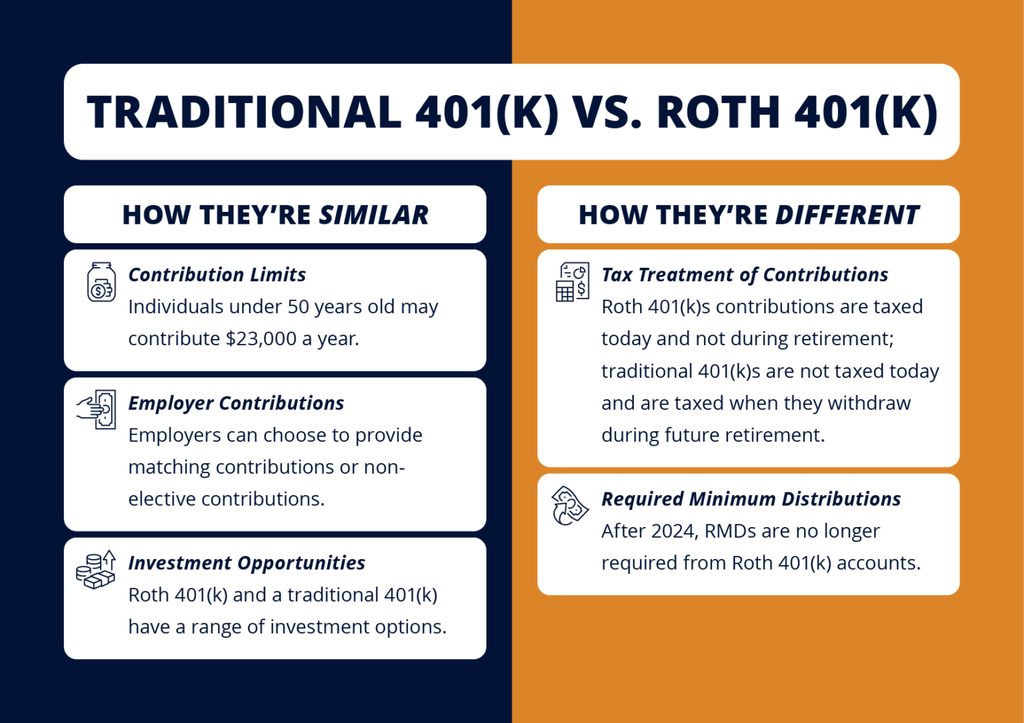
There are two primary ways to handle the taxes on these contributions:
- Traditional 401(k): Contributions are made on a pre-tax basis. This lowers your taxable income for the year you make the contribution, effectively lowering your current tax bill. You will pay income tax on these contributions and their earnings when you withdraw the money in retirement.
- Roth 401(k): Contributions are made on an after-tax basis. You do not get a tax break today, but qualified withdrawals in retirement are generally tax-free.
The Role of Employer Matching
One of the most significant advantages of a 401(k) is the potential for an employer match. Many companies offer to contribute a certain amount to your account based on your own contributions. For example, an employer might offer to match 50 cents for every dollar you contribute, up to a certain percentage of your salary.
This match is essentially additional compensation and is one of the most effective ways to boost your retirement savings. It is important to understand the concept of “vesting,” which refers to your ownership of the employer’s matching contributions. While you are always 100% vested in your own contributions, employer matching funds may require you to work for the company for a certain number of years before they officially become yours to keep.
Investment Options and Account Management
Once your money is inside the 401(k) account, it is not just sitting there as cash; it is invested. Your employer provides a menu of investment options—typically a variety of mutual funds, index funds, or target-date funds—which allow you to create a diversified portfolio based on your risk tolerance and time horizon.
Managing your account involves selecting these investments and occasionally rebalancing your portfolio to ensure it remains aligned with your goals. Because 401(k) plans are employer-sponsored, you are generally limited to the investment choices offered within the plan’s specific lineup.
Hypothetical Examples
To better understand how these plans function, consider the following hypothetical scenarios.
Example 1: The Impact of Employer Matching Imagine an employee earns $50,000 annually and decides to contribute 5% of their salary ($2,500) to their 401(k). Their employer offers a match of 50% on the first 6% contributed. The employee contributes $2,500, and the employer contributes an additional $1,250 (50% of the employee’s $2,500). In this case, the employee has put $2,500 into their account, but the account balance grew by $3,750.
Example 2: Traditional vs. Roth Considerations Imagine someone decides to contribute $5,000 to their account for the year. If they choose a Traditional 401(k), that $5,000 is deducted from their taxable income before taxes are calculated, potentially saving them money on their current year’s income tax return. If they choose a Roth 401(k), they pay taxes on that $5,000 now, but they will not pay taxes on that $5,000 or the investment growth it generates when they withdraw it in retirement.
Withdrawals, Rules, and Limitations
Retirement accounts like 401(k)s have specific rules about when and how you can access your money. Generally, 401(k) funds are intended for retirement. If you withdraw funds before reaching a certain age—typically 59½—you may be subject to income taxes and an additional early withdrawal penalty, unless a specific exception applies.
Furthermore, the federal government sets annual limits on how much an employee can contribute to their 401(k). These limits, along with income thresholds for certain tax advantages and catch-up contribution rules for older workers, are updated periodically. It is essential to check the latest contribution limits and rules published on official government websites.
Key Takeaways
- A 401(k) is an employer-sponsored retirement savings plan that allows you to invest a portion of your paycheck for your future.
- Contributions can be made on a pre-tax (Traditional) or after-tax (Roth) basis, depending on your plan’s options.
- Employer matching contributions are a valuable benefit that can significantly accelerate your savings growth.
- The money in your account is invested in options chosen by the plan, and you are responsible for managing your portfolio.
- Early withdrawals may be subject to taxes and penalties, as these accounts are intended for long-term retirement savings.
Frequently Asked Questions
What happens to my 401(k) if I change jobs? You generally have several options when leaving an employer. You can keep the money in your former employer’s plan (if allowed), move it to your new employer’s 401(k) plan, roll it over into an individual retirement account (IRA), or, in some cases, take a cash distribution. Each option has different tax and logistical implications, so consider them carefully.
How much should I contribute to my 401(k)? There is no single “right” amount, as it depends on your overall financial situation, retirement goals, and budget. Many financial professionals suggest aiming to contribute enough to at least get the full employer match, if available. Beyond that, you can adjust your contributions based on your personal savings targets and current financial capacity.
Are 401(k) investments guaranteed to make money? No. Investments in a 401(k) are subject to market risks, and the value of your account can go up or down. There are no guarantees of returns or profits. Your account balance depends entirely on the contributions made and the performance of the investments you select over time.
Can I borrow money from my 401(k)? Some plans allow participants to take a loan from their 401(k) account. If your plan offers this feature, you can borrow against your vested balance and pay it back with interest over a set period. However, failing to repay the loan on time can lead to it being treated as a taxable distribution, which may trigger taxes and penalties.
What is vesting in a 401(k)? Vesting refers to the ownership schedule of employer-provided matching funds. You are always 100% vested in the money you contribute from your own paycheck. Employer matching contributions, however, may be subject to a vesting schedule, meaning you may need to work for the employer for a specific number of years before those matching dollars are yours to keep.
Conclusion
A 401(k) is a fundamental tool for retirement planning in the United States, offering a structured way to save and invest over the course of your working years. By understanding how your contributions, employer matching, and investment choices work together, you can make informed decisions that align with your long-term goals. While these accounts offer significant benefits, they also come with specific rules regarding taxation, contributions, and withdrawals. Always rely on official government sources for the most current rules and limitations, and consider consulting with a qualified professional to ensure your approach fits your unique financial situation.
Sources and Further Reading
- Internal Revenue Service (IRS):
irs.gov – Provides comprehensive information on 401(k) rules, annual contribution limits, and tax implications.
- Securities and Exchange Commission (SEC):
investor.gov – Offers educational resources on investing, retirement planning, and understanding investment products.
- Department of Labor (DOL):
dol.gov – Provides guidance for plan participants regarding their rights and the management of retirement plans.
- Consumer Financial Protection Bureau (CFPB):
consumerfinance.gov – Includes tools and resources for managing personal finances and understanding complex financial products.
- Federal Reserve:
federalreserve.gov – Provides data and reports on the broader economic landscape and household finances.
Disclaimer
Disclaimer: This article is for educational purposes only and is not financial, investment, tax, or legal advice. The information provided is general in nature and does not consider your personal circumstances. We make no guarantees, promises, or representations about returns, profits, savings, credit outcomes, or any other results. All examples are hypothetical and for illustration only. Financial rules, interest rates, tax brackets, contribution limits, and fees change over time, so this article does not state current figures; please check official sources such as IRS.gov, SEC.gov, Investor.gov, CFPB, or the Federal Reserve for the latest information. Consult a qualified professional, such as a certified financial planner, tax professional, or attorney, before making financial decisions.
About the Author: [Author Name] is a seasoned financial writer with over a decade of experience demystifying complex topics for general audiences. They specialize in retirement planning, personal finance, and investment education.