
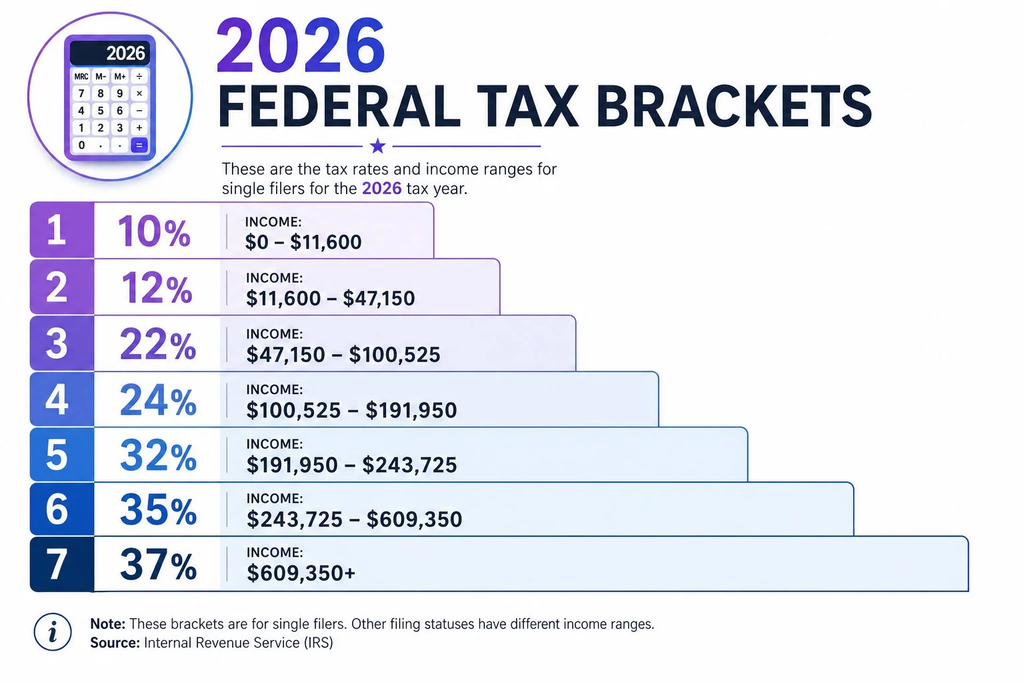
How Do US Federal Income Tax Brackets Work?
Federal income tax brackets determine how much tax individuals in the United States pay on different portions of their taxable income. The US uses a progressive tax system, which means that income is divided into sections, and each section is taxed at a different rate. Earning more money and moving into a higher tax bracket does not mean all your income is taxed at that higher rate. Only the portion of taxable income within the higher bracket is subject to the higher rate. Understanding how federal income tax brackets work can help taxpayers interpret their paychecks, understand their tax returns, and distinguish between their marginal tax rate and their overall tax rate.
1. What Are US Federal Income Tax Brackets?
US federal income tax brackets are income ranges assigned different tax rates by the federal government. They determine the rate applied to each portion of an individual’s taxable income.
The United States follows a progressive income tax structure. Under this system, lower portions of taxable income are generally taxed at lower rates, while additional income may be taxed at progressively higher rates.
This structure is designed so that people with higher taxable incomes generally pay a larger percentage on their additional income than people in lower income ranges.
Federal income tax brackets are not the same as total household income. The amount used to determine a taxpayer’s bracket is generally their taxable income after applicable adjustments and deductions.
The IRS publishes official tax rate schedules and filing instructions. Tax brackets and other tax rules can change, so taxpayers should consult IRS.gov for the figures that apply to the relevant tax year.
2. How Does the Progressive Tax System Work?
The progressive tax system divides taxable income into multiple ranges, often called brackets. Each range has its own tax rate.
A common misunderstanding is that reaching a higher tax bracket causes all income to be taxed at the new rate. This is incorrect. The higher rate generally applies only to the portion of taxable income that falls within that particular bracket.
For example, imagine a simplified tax system with three brackets:
- The first $20,000 is taxed at 10%.
- The next $30,000 is taxed at 15%.
- Income above $50,000 is taxed at 20%.
These figures are hypothetical and do not represent actual US federal tax brackets.
If someone has $60,000 in taxable income, the tax calculation would divide that income into three portions:
- First $20,000: taxed at 10%.
- Next $30,000: taxed at 15%.
- Remaining $10,000: taxed at 20%.
The taxpayer does not pay the highest rate on the entire $60,000. Instead, each portion is taxed according to its applicable bracket.
This is the central principle of progressive taxation.
Why Moving Into a Higher Tax Bracket Does Not Tax All Your Income More
A higher tax bracket affects only the additional income within that range. It does not automatically increase the tax rate applied to income already falling into lower brackets.
This distinction is important when evaluating a salary increase, bonus, promotion, or additional source of income.
Although earning more may increase someone’s overall tax bill, it does not mean the entire additional income or previous earnings are suddenly taxed at the highest applicable rate.
3. What Determines Your Federal Income Tax Bracket?
Several factors influence which federal income tax brackets apply to an individual. The most important include taxable income, filing status, and applicable deductions.
Taxable Income
Taxable income is the amount of income subject to federal income tax after applicable adjustments and deductions.
It is not necessarily equal to gross income, which generally represents income before deductions.
For many individual taxpayers, the calculation involves several stages:
- Add together taxable income from applicable sources.
- Subtract eligible adjustments to income to determine adjusted gross income (AGI).
- Subtract the applicable standard deduction or itemized deductions, along with any other deductions permitted under the tax rules.
- Determine the resulting taxable income.
The final taxable income figure is generally used to identify the applicable income tax brackets.
Different types of income may receive different tax treatment, so not every dollar received is necessarily taxed in the same way.
Filing Status
The IRS recognizes several federal income tax filing statuses. These statuses influence the tax brackets and deductions available to individuals.
The main filing statuses are:
- Single: Generally applies to individuals who are unmarried or legally separated and do not qualify for another filing status.
- Married Filing Jointly: Generally applies to married couples who choose to submit one federal income tax return together.
- Married Filing Separately: Applies to married individuals who file separate returns.
- Head of Household: May apply to certain unmarried individuals who meet specific household and dependent requirements.
- Qualifying Surviving Spouse: May apply to eligible individuals following the death of a spouse, subject to IRS requirements.
Two people with identical taxable incomes may fall into different brackets depending on their filing statuses.
Filing status can also affect deductions, credits, and eligibility for certain tax benefits.
4. Marginal Tax Rate vs. Effective Tax Rate
Understanding the difference between marginal and effective tax rates is essential for interpreting federal income tax brackets.
Although the terms are related, they describe two different measurements.
What Is the Marginal Tax Rate?
Your marginal tax rate is the tax rate applied to your next dollar of taxable income.
Under the progressive tax system, it is generally the rate associated with the highest bracket your taxable income reaches.
For example, someone whose taxable income extends into a particular bracket may have a marginal tax rate associated with that bracket. However, their income in the lower brackets continues to receive the lower applicable rates.
Marginal tax rates are useful for understanding how additional taxable income may affect a person’s federal income tax liability.
What Is the Effective Tax Rate?
Your effective tax rate represents the percentage of your taxable income or another clearly defined income measure paid in federal income tax.
For a simple illustration, suppose someone has:
- Taxable income: $50,000
- Total federal income tax: $5,000
Their effective federal income tax rate, calculated using taxable income, would be:
$5,000 ÷ $50,000 × 100 = 10%
This does not mean every dollar was taxed at 10%. The amount represents the average tax burden across the taxable income used in the calculation.
Effective tax rates are generally lower than marginal tax rates under a progressive system, although the exact relationship depends on the individual’s circumstances and applicable taxes.
5. How Deductions and Tax Credits Affect Your Tax Bill
Deductions and tax credits both influence federal income taxes, but they work differently.
How Tax Deductions Work
A tax deduction reduces the amount of income subject to taxation.
For individual taxpayers, two commonly discussed deduction methods are the standard deduction and itemized deductions.
Standard deduction: This is a fixed deduction amount established under federal tax law. Its availability and amount depend on factors such as filing status and other applicable circumstances.
Itemized deductions: These allow eligible taxpayers to deduct qualifying expenses reported under applicable IRS rules. Examples may include certain medical expenses, charitable contributions, and qualifying mortgage interest.
Generally, taxpayers compare the available deduction methods and follow the rules governing which approach they may use.
Reducing taxable income may also affect which tax brackets apply.
How Tax Credits Work
Tax credits directly reduce the amount of tax owed rather than reducing taxable income.
Depending on eligibility and the type of credit, some credits may also be refundable, meaning an eligible taxpayer could receive an amount beyond their remaining tax liability.
Examples of federal tax credits include:
- Child Tax Credit.
- Earned Income Tax Credit.
- Education-related tax credits.
- Certain credits for qualifying childcare expenses.
Eligibility requirements, income restrictions, and credit amounts vary. The IRS publishes current rules and instructions for individual credits.
The important distinction is that deductions generally reduce taxable income, while credits reduce calculated tax liability.
6. How Federal Income Tax Brackets Affect Your Paycheck
Federal income tax brackets influence how much federal income tax an individual may owe, but they do not directly determine the exact amount withheld from every paycheck.
The US federal income tax system generally operates on a pay-as-you-go basis. Many employees have federal income taxes withheld from their wages by their employers.
Employers generally use information provided on Form W-4, along with applicable withholding procedures, to calculate how much federal income tax to withhold.
Withholding is an advance payment toward an individual’s expected federal income tax liability. It is not necessarily the final amount owed.
When taxpayers file their annual federal income tax returns, they compare their total tax liability with payments already made through withholding and estimated taxes.
The result may be:
- A tax refund: When eligible payments and withholding exceed the final tax liability.
- An additional tax payment: When the final tax liability exceeds payments already made.
- No additional balance or refund: When payments and tax liability are approximately equal.
People with self-employment income, investment income, or multiple income sources may have different tax payment responsibilities.
The IRS explains withholding and estimated tax requirements in its official tax publications.
7. Practical Examples of How Tax Brackets Work
The following examples demonstrate how progressive taxation works. They use simplified, hypothetical tax rates and income figures for educational purposes only. They are not actual federal tax calculations.
Example 1: A Person Whose Income Falls Into Two Tax Brackets
Imagine someone has $40,000 in taxable income under a hypothetical tax system with these brackets:
- First $20,000 taxed at 10%.
- Remaining income up to $50,000 taxed at 15%.
The calculation would be:
- First $20,000 × 10% = $2,000.
- Remaining $20,000 × 15% = $3,000.
Total hypothetical income tax: $5,000.
The marginal tax rate is 15%, while the effective tax rate is 12.5%.
This demonstrates that the taxpayer does not pay 15% on the entire $40,000.
Example 2: Receiving a Salary Increase
Imagine an employee earns $50,000 in taxable income and later receives a salary increase that brings taxable income to $60,000.
Using the same hypothetical tax brackets:
- First $20,000 is taxed at 10%.
- The next $30,000 is taxed at 15%.
- The additional $10,000 is taxed at 20%.
The original $50,000 remains divided between the first two brackets. Only the additional $10,000 falls into the third bracket.
This illustrates why moving into a higher tax bracket does not automatically make a salary increase financially disadvantageous through federal income tax alone.
Actual tax outcomes may also depend on deductions, credits, other taxes, and the treatment of different income sources.
8. Important Limitations and Common Tax Bracket Misunderstandings
Federal income tax brackets provide a useful framework, but they do not explain every part of an individual’s tax situation.
Some important considerations include:
- State and local taxes: Federal income tax brackets are separate from state and local income tax systems. Applicable state and local taxes depend on where a person lives and works.
- Capital gains: Certain investment gains may be subject to different federal tax rates and rules than ordinary income.
- Self-employment taxes: Self-employed individuals may owe additional taxes beyond regular federal income tax.
- Additional taxes: Certain income levels or financial circumstances may trigger other federal taxes.
- Changing tax laws: Brackets, deductions, credits, and eligibility requirements can change over time.
Another common misunderstanding is that a tax refund represents extra income or a special government payment. A refund generally reflects an overpayment of tax during the year, subject to the individual’s tax situation.
Understanding these limitations helps explain why two people with similar earnings may have different final tax bills.
Key Takeaways
- US federal income tax brackets are part of a progressive tax system in which different portions of taxable income are taxed at different rates.
- Moving into a higher bracket does not mean all your income is taxed at the higher rate.
- Taxable income, filing status, and eligible deductions influence which brackets apply.
- The marginal tax rate applies to the next dollar of taxable income, while the effective tax rate measures the average tax burden.
- Tax deductions reduce taxable income, while tax credits directly reduce tax liability.
Frequently Asked Questions (FAQ)
1. What happens when you move into a higher tax bracket?
When your taxable income enters a higher tax bracket, only the portion within that higher bracket is generally taxed at the higher rate. Income in the lower brackets continues to receive the corresponding lower rates. Therefore, earning more money does not automatically cause all your income to be taxed at a higher percentage.
2. Are federal income tax brackets based on gross income or taxable income?
Federal income tax brackets generally apply to taxable income rather than gross income. Taxable income is calculated after applicable adjustments and deductions. As a result, someone earning a particular salary may have a lower taxable income after accounting for eligible deductions and other permitted adjustments.
3. Do married couples have different federal income tax brackets?
Yes. The federal tax system provides different tax bracket structures for different filing statuses, including married filing jointly and married filing separately. Eligible taxpayers may also qualify for other filing statuses, such as head of household. The filing status used on a tax return can influence the applicable tax rates and deductions.
4. What is the difference between a marginal and an effective tax rate?
The marginal tax rate is the rate applied to the next dollar of taxable income. The effective tax rate represents the average tax paid relative to a specified income amount. Because federal income tax is progressive, a person’s effective tax rate is generally lower than their marginal rate, although individual circumstances can affect the calculation.
5. Do federal income tax brackets change every year?
Federal tax brackets can change because of inflation adjustments and changes in tax legislation. Other tax provisions, including deductions and credits, may also change. The IRS publishes the applicable tax information for each tax year. Taxpayers should consult official IRS publications and instructions rather than relying on outdated bracket tables or previous-year calculations.
Conclusion
Understanding how US federal income tax brackets work makes it easier to interpret federal tax rates, evaluate taxable income, and understand how additional earnings may affect tax liability. The progressive tax system applies different rates to different portions of taxable income rather than taxing every dollar at the highest applicable rate. Filing status, deductions, credits, and other tax rules also influence the final calculation. Because tax laws and income thresholds can change, official IRS publications remain an important source of accurate information when reviewing federal income tax requirements.
Sources and Further Reading
The following official US government resources provide additional information about federal income taxes and related rules:
- Internal Revenue Service (IRS): https://www.irs.gov/ — Official federal tax information, forms, publications, and tax guidance.
- IRS – Credits and Deductions for Individuals: https://www.irs.gov/credits-and-deductions-for-individuals — Information about deductions and tax credits available to individuals.
- IRS – Tax Withholding: https://www.irs.gov/individuals/employees/tax-withholding — Guidance on paycheck withholding, Form W-4, and federal income tax payments.
- IRS – Instructions for Form 1040: https://www.irs.gov/instructions/i1040gi — Instructions for individual federal income tax returns and applicable tax calculations.
Disclaimer
Disclaimer: This article is for educational purposes only and is not financial, investment, tax, or legal advice. The information provided is general in nature and does not consider your personal circumstances. We make no guarantees, promises, or representations about returns, profits, savings, credit outcomes, or any other results. All examples are hypothetical and for illustration only. Financial rules, interest rates, tax brackets, contribution limits, and fees change over time, so this article does not state current figures; please check official sources such as IRS.gov, SEC.gov, Investor.gov, CFPB, or the Federal Reserve for the latest information. Consult a qualified professional, such as a certified financial planner, tax professional, or attorney, before making financial decisions.
About the Author: [Author Name] is [credentials/experience in finance, writing, or research]. [One or two sentences about expertise.]