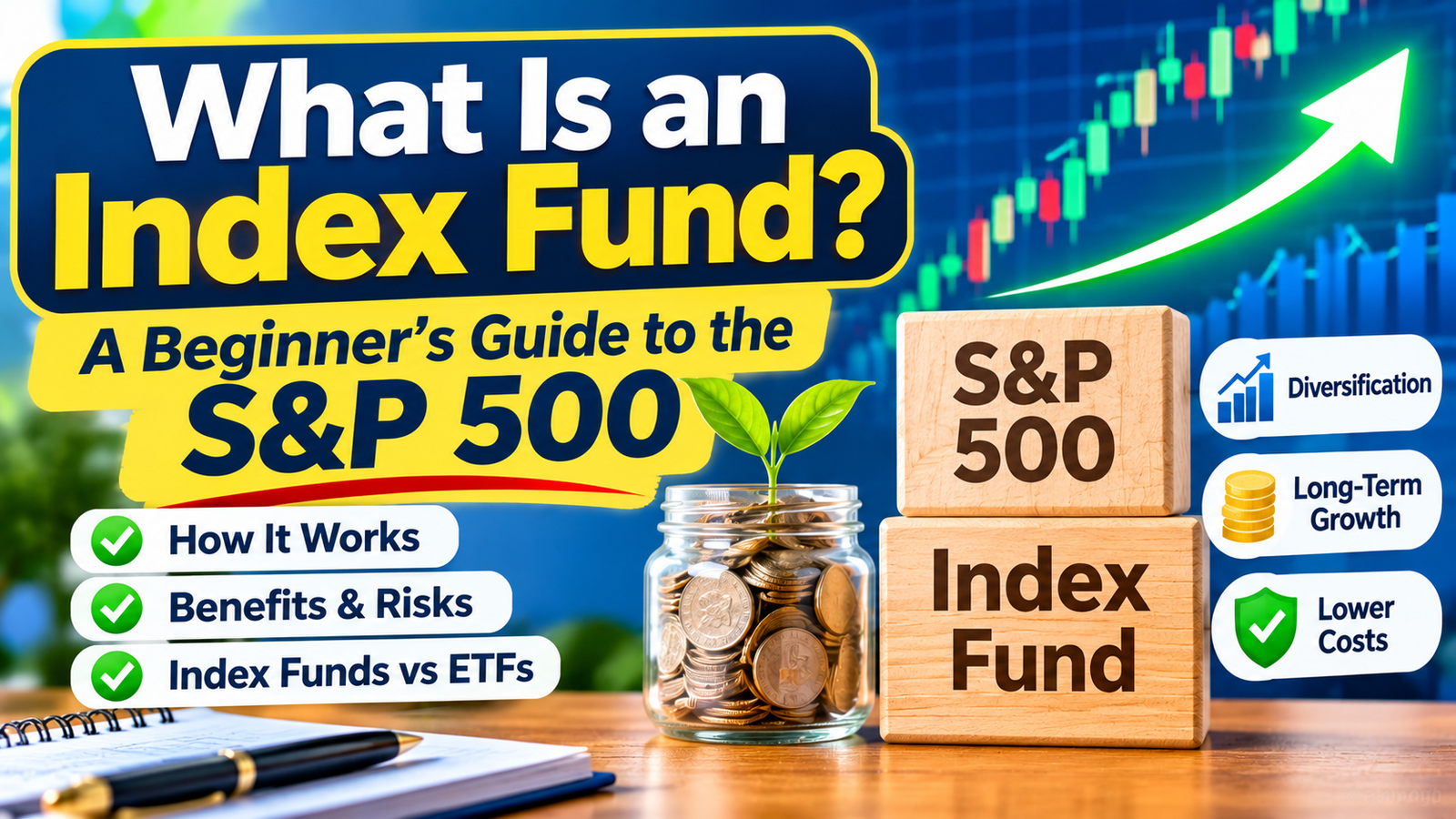
An index fund is an investment fund that aims to track the performance of a specific stock market index rather than selecting individual stocks in an attempt to outperform the market. One of the best-known examples is an S&P 500 index fund, which follows an index representing 500 leading publicly traded US companies. Index funds allow investors to gain exposure to multiple companies through a single investment. They are commonly discussed in connection with retirement accounts, long-term investing, and portfolio diversification. Understanding how index funds work, what the S&P 500 measures, and what risks they involve can help beginners make sense of one of the most widely used investment approaches in the United States.
What Is an Index Fund?
An index fund is a type of mutual fund or exchange-traded fund (ETF) designed to follow a particular market index. Instead of having a fund manager actively choose individual investments in an attempt to outperform the market, an index fund generally holds investments that represent the index it tracks.
A market index measures the performance of a selected group of securities. These securities may include stocks or bonds from particular companies, industries, or sections of the financial market.
For example, an S&P 500 index fund attempts to follow the performance of the S&P 500, an index representing 500 leading publicly traded US companies.
The main characteristics of index funds include:
- Passive management: The fund generally follows predetermined index rules rather than relying on frequent investment decisions by a manager.
- Diversification: A single fund may provide exposure to many different companies.
- Market tracking: The fund attempts to produce returns that closely follow its chosen index, before applicable fees and expenses.
- Operating costs: Some index funds have relatively low expenses because they require less active portfolio management.
Index funds are available as traditional mutual funds and ETFs. Although both structures can follow the same index, they have different trading and operational features.
What Is the S&P 500?
The S&P 500, also known as the Standard & Poor’s 500, is a stock market index designed to measure the performance of large US companies.
It includes 500 selected companies listed on US stock exchanges. These companies represent different industries, including technology, healthcare, financial services, consumer products, energy, and industrial businesses.
The S&P 500 is widely followed because it provides a useful picture of how a substantial portion of the US large-company stock market is performing.
How Are Companies Selected?
Companies do not automatically enter the S&P 500 simply because they are large or popular.
A committee at S&P Dow Jones Indices evaluates potential companies using established eligibility and selection criteria. These considerations include factors such as market capitalization, liquidity, public float, financial viability, and sector representation.
The index is reviewed periodically, and its membership can change as companies become eligible or no longer meet its requirements.
How Is the S&P 500 Weighted?
The S&P 500 is a market-capitalization-weighted index, adjusted for the shares available to public investors.
Market capitalization represents the total market value of a company’s outstanding shares. In a market-cap-weighted index, larger eligible companies generally have a greater influence on the index’s overall performance.
For example, a company with a much larger market value may have a greater effect on the S&P 500 than a smaller company.
This means the index does not give every company an equal influence. Its performance can be significantly affected by the largest companies in the group.
The S&P 500 is not a complete representation of every publicly traded company in the United States. It primarily measures the large-cap segment of the US stock market.
How Does an S&P 500 Index Fund Work?
An S&P 500 index fund attempts to match the performance of the S&P 500 by holding stocks included in the index or using another tracking method.
When an investor purchases shares of an S&P 500 index fund, the investment provides exposure to the fund’s portfolio rather than ownership of all 500 companies directly in separate brokerage transactions.
The fund collects money from investors and uses its assets to purchase securities according to its investment strategy.
There are two common approaches to tracking an index:
1. Full Replication
A fund using full replication attempts to hold all the stocks in the underlying index, generally in proportions that reflect their index weights.
For example, if a particular company represents a certain percentage of the S&P 500, the fund attempts to maintain a similar proportion of that company’s stock in its portfolio.
This approach can help the fund closely follow the index.
2. Representative Sampling
Some index funds use representative sampling instead of holding every security.
Under this method, the fund selects a group of securities intended to represent the overall characteristics of the index.
The selection may consider industry exposure, company size, risk characteristics, and other factors.
Sampling can help manage the practical challenges of tracking an index, although it may result in differences between the fund’s performance and the index.
What Happens When the S&P 500 Changes?
When a company is added to or removed from the index, an index fund generally adjusts its holdings to reflect the updated composition.
This helps the fund continue following the index’s investment rules.
However, buying and selling securities to maintain alignment can create transaction costs and small differences in performance.
What Are the Benefits of Index Funds?
Index funds have become an important part of the investment landscape because of several features that may appeal to investors.
1. Broad Company Exposure
An S&P 500 index fund provides exposure to hundreds of large US companies through one investment.
This can reduce the dependence on the financial performance of a single company compared with holding only one or two individual stocks.
However, owning many stocks does not eliminate investment risk.
2. Generally Lower Management Costs
Traditional index funds usually require less active research and security selection than actively managed funds.
Because the investment strategy follows an established index, operating expenses may be lower.
However, costs differ between funds. Investors may encounter annual expense ratios, brokerage transaction costs, and other charges depending on the fund and account.
Even relatively small expenses can reduce investment returns over time.
3. Transparency
Index funds generally follow a clearly defined benchmark.
Investors can review the index methodology and examine the fund’s investment objective, holdings, and expenses through its prospectus and shareholder reports.
This can make it easier to understand what an index fund is designed to track.
4. A Long-Term Investment Approach
Index funds are commonly associated with long-term investing because they generally do not attempt to predict short-term stock market movements.
Their passive structure focuses on following an index rather than frequently changing investments based on market forecasts.
Nevertheless, a long-term approach does not guarantee positive returns or prevent losses.
What Are the Risks and Limitations of Index Funds?
Index funds offer several potential advantages, but they also involve risks that beginners should understand.
1. Market Risk
An S&P 500 index fund is exposed to stock market fluctuations.
If the companies included in the index lose value, the fund’s share price or net asset value may decline.
Investors can lose some or all of the money they invest, depending on market performance and when they sell.
2. Concentration Risk
Although the S&P 500 contains hundreds of companies, it is weighted by market capitalization.
Consequently, its largest companies can account for a substantial portion of the index.
This means the fund may be more exposed to certain large companies and industries than its company count initially suggests.
3. Tracking Error
An index fund may not produce exactly the same return as its benchmark.
Differences can occur because of:
- Management expenses.
- Trading costs.
- Cash holdings.
- Dividend timing.
- Portfolio sampling.
- Changes in index membership.
These differences are commonly described as tracking differences or tracking error, depending on how they are measured.
4. Limited Flexibility
Traditional index funds generally follow their index rather than avoiding companies because of short-term business difficulties or changing economic conditions.
If a company remains in the index, the fund may continue holding its shares according to its tracking strategy.
This differs from an actively managed fund, where the manager has more discretion to change holdings.
5. No Guaranteed Returns
An index fund does not guarantee profits or protect investors from market declines.
Even a widely followed index such as the S&P 500 can experience significant losses during periods of economic uncertainty or declining stock prices.
Past performance does not guarantee future results.
Hypothetical Examples: How S&P 500 Index Funds Work
The following examples are hypothetical and illustrative only. They do not represent actual fund performance or predict future investment results.
Example 1: Understanding Diversification
Imagine someone has $1,000 available for investing.
Instead of purchasing shares of one individual company, the person purchases shares of an S&P 500 index fund.
The fund provides exposure to a portfolio representing hundreds of large US companies.
If one company performs poorly, its decline may have a smaller effect on the overall portfolio than it would in an investment consisting entirely of that company’s stock.
However, if the broader stock market declines, the index fund may also lose value.
This example demonstrates how index funds spread exposure across multiple companies without eliminating market risk.
Example 2: Understanding Investment Expenses
Imagine two hypothetical index funds track the same market index and each has an initial investment of $10,000.
Fund A has annual operating expenses of 0.10%, while Fund B has annual operating expenses of 0.50%.
Assuming identical underlying investment performance, Fund B’s higher expenses would reduce the amount remaining for investors compared with Fund A.
The difference may seem small initially, but expenses can accumulate over extended periods.
Actual results would also depend on other costs, trading activity, taxes, and investment performance.
How Are Index Funds Different From ETFs and Mutual Funds?
One common source of confusion for beginners is the difference between an index fund, a mutual fund, and an ETF.
An index fund describes an investment strategy. Mutual fund and ETF describe investment fund structures.
An index fund can therefore be structured as either a mutual fund or an ETF.
| Feature | Index Mutual Fund | Index ETF |
|---|---|---|
| Investment strategy | Tracks an index | Tracks an index |
| Trading | Generally once daily after market close | Trades throughout the trading day |
| Pricing | Based on end-of-day NAV | Market price can change during the day |
| Minimum investment | Depends on the fund | Depends on share price and brokerage features |
| Expenses | Vary by fund | Vary by fund |
What Is a Mutual Fund?
A mutual fund pools money from multiple investors and invests it in a portfolio of securities.
Investors purchase shares directly through the fund or through an eligible financial intermediary.
Mutual fund transactions generally occur at the next calculated net asset value (NAV) after an order is received.
What Is an ETF?
An exchange-traded fund is a pooled investment fund whose shares trade on a stock exchange.
ETF investors generally buy and sell shares through brokerage accounts during market hours.
The market price may differ slightly from the fund’s NAV because of supply and demand.
Both structures can be used to track the S&P 500.
What Should Beginners Understand Before Investing in an Index Fund?
Understanding an index fund’s structure and costs is important before evaluating how it fits into a broader financial picture.
Here are several factors worth understanding:
- Investment objective: Identify which market index the fund attempts to track.
- Expense ratio: Understand the annual operating expenses charged by the fund.
- Portfolio holdings: Review the companies and industries represented in the fund.
- Tracking performance: Understand how closely the fund has followed its benchmark.
- Investment risks: Consider market volatility, concentration, and potential losses.
- Tax considerations: Understand how dividends, capital gains distributions, and investment sales may affect federal taxes.
Index funds may also be held within different types of US investment accounts, including taxable brokerage accounts, traditional IRAs, Roth IRAs, and employer-sponsored retirement plans.
The account structure can affect tax treatment, withdrawal rules, and other financial considerations.
Investors can review official fund documents, including the prospectus and shareholder reports, to understand a fund’s investment strategy and costs.
Key Takeaways
- An index fund is an investment fund designed to track a specific market index.
- The S&P 500 measures the performance of 500 selected large US companies.
- S&P 500 index funds provide exposure to multiple companies through one investment.
- Index funds may have relatively low operating expenses, but costs vary between funds.
- Index funds involve market risk, and investors can lose money even when investing in a diversified fund.
Frequently Asked Questions About Index Funds
1. What is an index fund in simple terms?
An index fund is an investment fund that follows a group of stocks or bonds represented by a market index. Rather than actively selecting investments to outperform the market, it attempts to match the performance of its chosen benchmark. An S&P 500 index fund, for example, provides exposure to a portfolio designed to follow the S&P 500.
2. Is the S&P 500 an index fund?
No. The S&P 500 is a stock market index, not an investment fund. It measures the performance of 500 selected large US companies. Investors cannot purchase the index directly, but mutual funds and ETFs are available that attempt to track its performance.
3. Can you lose money in an S&P 500 index fund?
Yes. An S&P 500 index fund invests in stocks, and stock prices can decline. If the underlying companies lose market value, the fund’s value may also decrease. Diversification can reduce dependence on individual companies, but it cannot eliminate the risk of broader stock market losses.
4. Are index funds and ETFs the same thing?
No. An index fund describes an investment strategy, while an ETF describes a fund structure. An ETF can track an index, making it an index ETF. Similarly, a traditional mutual fund can follow an index. The two structures have different trading and pricing arrangements.
5. Do index funds pay dividends?
Some index funds receive dividends from the companies whose stocks they hold. Depending on the fund’s structure and policies, these dividends may be distributed to investors or reinvested. Dividend payments are not guaranteed and can change depending on the companies’ financial performance and distribution decisions.
Conclusion
An index fund is an investment fund designed to follow a market benchmark rather than actively select individual securities to outperform the market. The S&P 500 is one of the best-known benchmarks in the United States, representing 500 selected large companies across different industries. Index funds can provide broad company exposure, transparent investment strategies, and potentially lower operating expenses. However, they still carry market risk, and their values can decline. Understanding how index funds work, how the S&P 500 is constructed, and what costs and limitations apply provides a useful foundation for learning about the US investment market.
Sources and Further Reading
The following reputable US resources provide additional information about index funds, ETFs, mutual funds, investment risks, and the S&P 500.
- Investor.gov – Index Funds
https://www.investor.gov/introduction-investing/investing-basics/investment-products/mutual-funds-and-exchange-traded-4
Explains how index funds operate, their costs, and their potential risks. - Investor.gov – Mutual Funds and ETFs
https://www.investor.gov/introduction-investing/investing-basics/investment-products
Provides educational information about pooled investment products. - SEC – Asset Allocation and Diversification
https://www.sec.gov/investor/pubs/assetallocation.htm
Explains diversification, investment risk, and asset allocation. - S&P Dow Jones Indices – S&P U.S. Indices Methodology
https://www.spglobal.com/spdji/en/methodology/article/sp-us-indices-methodology/
Provides information about how US market indices, including the S&P 500, are constructed. - Investor.gov – Introduction to Investing
https://www.investor.gov/introduction-investing
Offers educational resources about investment products, risk, and financial markets.
Disclaimer
Disclaimer: This article is for educational purposes only and is not financial, investment, tax, or legal advice. The information provided is general in nature and does not consider your personal circumstances. We make no guarantees, promises, or representations about returns, profits, savings, credit outcomes, or any other results. All examples are hypothetical and for illustration only. Financial rules, interest rates, tax brackets, contribution limits, and fees change over time, so this article does not state current figures; please check official sources such as IRS.gov, SEC.gov, Investor.gov, CFPB, or the Federal Reserve for the latest information. Consult a qualified professional, such as a certified financial planner, tax professional, or attorney, before making financial decisions.
About the Author
About the Author: [Author Name] is [credentials/experience in finance, writing, or research]. [One or two sentences about expertise.]
SEO Details (Separate from Article)
Meta title: What Is an Index Fund? Beginner’s Guide to the S&P 500
Meta description: Learn what index funds are, how the S&P 500 works, their benefits and risks, and how index funds differ from ETFs and mutual funds.
Suggested URL slug:
what-is-an-index-fund
5 Related Keywords:
- S&P 500 index fund
- How index funds work
- Index funds for beginners
- Index funds vs ETFs
- Passive investing explained
Editorial review: The article covers the requested first title only, includes two hypothetical examples, five FAQs, seven educational sections, official sources, and the exact disclaimer. It avoids specific current market returns, investment guarantees, and personalized investment recommendations.