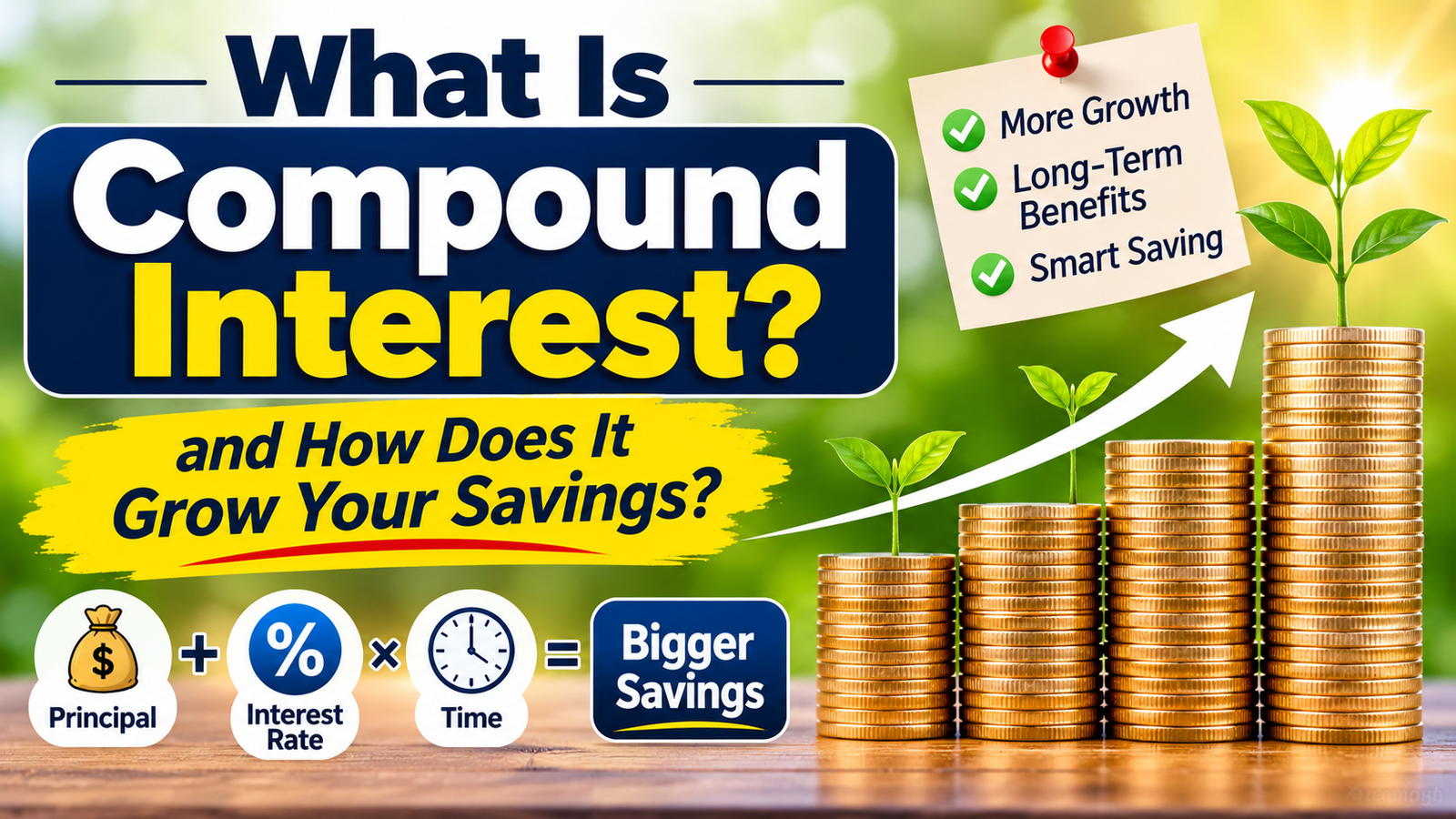
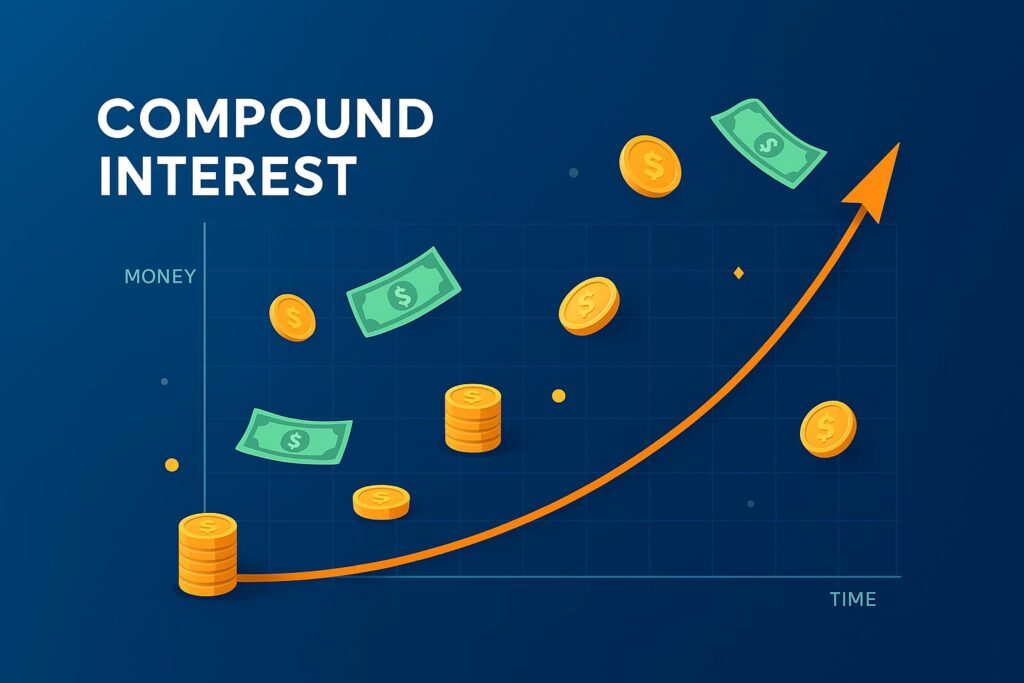
Compound interest is the process of earning interest on both your original money and the interest that has already accumulated. It allows savings to grow over time because previously earned interest becomes part of the balance used to calculate future interest. Unlike simple interest, which is calculated only on the original amount, compound interest can create increasingly larger earnings as time passes. This concept is important for understanding savings accounts, certificates of deposit (CDs), retirement accounts, and certain investments. Learning how compound interest works can help beginners understand why saving consistently and allowing money to remain in an account for longer periods may make a difference to long-term financial growth.
What Is Compound Interest
Compound interest is interest calculated on an initial amount of money, known as the principal, plus any interest that has accumulated from previous periods.
In simple terms, your money earns interest, and that interest can also begin earning interest. This creates a cycle in which the account balance may grow more quickly over time than it would under a simple interest arrangement, assuming the interest rate and other conditions remain unchanged.
For example, imagine someone deposits $1,000 into a hypothetical savings account that earns interest. After the first interest payment, the account balance increases. During the next interest period, interest may be calculated using the new, higher balance rather than only the original $1,000.
This process continues as interest is added to the balance.
Three important terms help explain compound interest:
- Principal: The original amount of money deposited or invested.
- Interest rate: The percentage used to calculate interest earned or owed.
- Compounding period: How frequently accumulated interest is added to the balance.
Compound interest can work in favor of savers when they earn interest, but it can also increase the amount owed on debts when interest is added to an outstanding balance.
How Does Compound Interest Work
Compound interest works by adding earned interest to the principal so that future interest calculations can include both amounts.
The process generally follows these steps:
- A person deposits or invests an initial amount of money.
- The account earns interest based on its applicable terms.
- The earned interest is added to the account balance.
- Future interest is calculated using the updated balance.
- The cycle continues over subsequent compounding periods.
The longer money remains in an account earning compound interest, the more opportunities it has to accumulate additional interest.
A Hypothetical Example of Compound Interest
Imagine someone deposits $1,000 into a hypothetical account earning 5% annual interest, compounded once per year.
For simplicity, assume the interest rate remains unchanged, there are no additional deposits or withdrawals, and no taxes or fees apply.
The balance would develop as follows:
| Year | Starting Balance | Interest Earned | Ending Balance |
|---|---|---|---|
| 1 | $1,000 | $50 | $1,050 |
| 2 | $1,050 | $52.50 | $1,102.50 |
| 3 | $1,102.50 | $55.13 | $1,157.63 |
| 4 | $1,157.63 | $57.88 | $1,215.51 |
| 5 | $1,215.51 | $60.78 | $1,276.28 |
Hypothetical and illustrative only.
Notice that the interest earned increases each year even though the assumed interest rate stays the same.
This happens because the account earns interest on an increasingly larger balance. By the end of the fifth year, the original $1,000 has grown to approximately $1,276.28.
The additional growth comes from earning interest on previously accumulated interest.
What Is the Difference Between Compound Interest and Simple Interest
Compound interest and simple interest are two methods of calculating interest, but they produce different results over time.
Simple interest is calculated only on the original principal. The interest earned does not become part of the amount used to calculate future interest.
Compound interest is calculated on the principal plus previously accumulated interest.
Consider another hypothetical example.
Imagine two people each deposit $2,000 into separate accounts. Both accounts have the same assumed annual interest rate of 5%.
- Account A earns simple interest.
- Account B earns interest compounded annually.
After the first year, both accounts earn $100 in interest.
However, their growth differs in later years:
| Year | Simple Interest | Compound Interest |
|---|---|---|
| 1 | $2,100 | $2,100 |
| 2 | $2,200 | $2,205 |
| 3 | $2,300 | $2,315.25 |
| 4 | $2,400 | $2,430.76 |
| 5 | $2,500 | $2,552.56 |
Hypothetical and illustrative only.
After five years, the compound interest account has a higher balance because interest earned in earlier years also generates additional interest.
The difference may appear relatively small over a short period, but it can become more noticeable over longer periods.
Neither method is automatically better in every financial situation. The result depends on the account agreement, interest rate, fees, taxes, and other conditions.
What Factors Affect Compound Interest Growth
Several factors determine how much an account may grow through compound interest.
Understanding these factors makes it easier to see why two savings accounts with different terms can produce different results.
1. Initial Deposit
The initial deposit, or principal, provides the starting point for calculating interest.
Generally, a larger principal can generate more interest than a smaller principal when the interest rate and compounding frequency are the same.
For example, an account starting with $5,000 would generally earn more interest than an account starting with $1,000 under otherwise identical conditions.
2. Interest Rate
The interest rate directly affects how much interest an account earns.
A higher rate generally produces more compound interest than a lower rate when the other conditions remain equal.
For savings accounts, financial institutions may offer variable rates that change over time. Therefore, the actual growth may differ from an estimate based on a constant rate.
3. Time
Time is one of the most important factors in compound interest.
When interest continues accumulating and being added to the principal, the account has more opportunities to generate interest on its growing balance.
This is why long-term savings calculations often demonstrate a larger effect from compounding than short-term calculations.
4. Compounding Frequency
Compounding frequency describes how often interest is added to the balance.
Common compounding schedules include:
- Daily compounding.
- Monthly compounding.
- Quarterly compounding.
- Annual compounding.
When the nominal annual interest rate is the same, more frequent compounding generally produces a slightly higher balance, assuming the same starting amount and other conditions.
However, the difference depends on the interest rate and the account’s terms.
5. Additional Deposits and Withdrawals
Regular deposits can increase the amount of money available to earn interest.
For example, someone who adds $100 to a savings account each month may accumulate interest on both the original deposit and eligible additional deposits.
Withdrawals have the opposite effect. Removing money reduces the balance available to generate future interest.
What Is the Compound Interest Formula
The compound interest formula provides a mathematical way to estimate how money may grow over time.
The standard formula for an initial deposit with no additional contributions or withdrawals is:
A = P(1 + r/n)^(nt)
Here is what each letter represents:
- A: The final account balance.
- P: The initial principal.
- r: The annual interest rate expressed as a decimal.
- n: The number of compounding periods per year.
- t: The number of years.
Understanding the Formula With an Example
Imagine someone deposits $1,000 into a hypothetical account earning 4% annual interest, compounded monthly.
The values are:
- Principal: $1,000
- Annual interest rate: 0.04
- Compounding periods: 12
- Time: 5 years
Using the formula:
A = 1,000(1 + 0.04/12)^(12 × 5)
The estimated ending balance is approximately $1,221.39.
Hypothetical and illustrative only.
This calculation assumes a constant interest rate, monthly compounding, and no additional deposits, withdrawals, taxes, or fees.
The formula is useful for understanding potential growth, but actual account balances depend on the financial institution’s calculation methods and account conditions.
Where Can Americans Earn Compound Interest
Compound interest can apply to several types of financial accounts and products in the United States.
1. Savings Accounts
Savings accounts at banks and credit unions may pay interest on deposited money.
Depending on the account’s terms, earned interest may be added to the balance and included in future interest calculations.
The interest rate may be variable, meaning it can change over time.
2. Certificates of Deposit (CDs)
Certificates of deposit are deposit accounts that generally hold money for a specified term.
Depending on the CD agreement, interest may compound during the term. The compounding schedule, withdrawal restrictions, and payment arrangements vary by institution and account.
CDs issued by FDIC-insured banks may qualify for deposit insurance within applicable coverage limits and requirements.
3. Retirement Accounts
Certain retirement accounts, including traditional and Roth individual retirement accounts (IRAs) and employer-sponsored retirement plans such as 401(k)s, can benefit from compounding.
However, the growth in these accounts often comes from investment returns rather than a guaranteed interest rate.
Investment returns can fluctuate, and account values may decline as well as increase. Tax treatment also depends on the account type and applicable rules.
4. Money Market Deposit Accounts
Money market deposit accounts offered by banks and credit unions may pay interest on deposited funds.
Interest calculation and compounding arrangements depend on the institution’s account terms.
These deposit accounts should not be confused with money market mutual funds, which are investment products and are not FDIC-insured bank deposits.
Key Takeaways
- Compound interest means earning interest on both your original principal and previously accumulated interest.
- The principal, interest rate, time, and compounding frequency all influence potential account growth.
- Compound interest can produce greater growth over time than simple interest under otherwise identical conditions.
- Savings accounts, CDs, and certain retirement accounts can involve compounding.
- Compound interest also applies to certain debts, where accumulating interest can increase the amount owed.
Frequently Asked Questions About Compound Interest
1. What is a simple example of compound interest
Imagine depositing $1,000 into a hypothetical savings account earning 5% annual interest, compounded yearly. After the first year, the balance becomes $1,050. During the second year, interest is calculated on $1,050 rather than just the original $1,000. This allows previously earned interest to generate additional interest.
2. Is compound interest better than simple interest
For someone earning interest, compound interest generally produces more growth than simple interest when the principal, rate, and time are identical. However, compound interest can also increase the cost of certain debts. Whether it benefits someone depends on whether they are earning interest or paying it, along with the applicable account or loan terms.
3. How often does compound interest accumulate
Compound interest can accumulate daily, monthly, quarterly, annually, or according to another schedule specified in an account agreement. More frequent compounding generally produces slightly more growth when the nominal annual rate and other conditions are identical. The actual interest calculation and crediting schedule depend on the financial institution and the specific account.
4. Can compound interest make savings grow without additional deposits
Yes. An account earning compound interest can grow even when no additional deposits are made. Previously accumulated interest becomes part of the balance and can generate further interest. However, the amount of growth depends on the interest rate, compounding schedule, time, and any applicable taxes or fees.
5. Is compound interest guaranteed in a savings account
Interest earnings depend on the account agreement and its applicable rate. Some accounts have variable interest rates that can change, while others may have fixed rates for a specified period. Even when an account earns interest, fees, withdrawals, and taxes may affect its overall growth. It is important to understand the account’s terms before estimating future balances.
Conclusion
Compound interest is an important financial concept that explains how money can grow through the accumulation of interest over time. By earning interest on both the original principal and previously earned interest, an account may experience increasing growth as its balance rises. The amount accumulated depends on factors such as the initial deposit, interest rate, compounding frequency, and time. Understanding compound interest can help individuals interpret savings account terms, compare interest calculations, and better understand long-term financial growth. It is equally important to recognize that rates, taxes, fees, and account conditions can affect actual results.
Sources and Further Reading
The following official US resources provide additional information about compound interest, savings, investment growth, and related financial topics.
- Investor.gov – Compound Interest Calculator
https://www.investor.gov/financial-tools-calculators/calculators/compound-interest-calculator
Provides an educational calculator for estimating how money may grow through compounding. - Consumer Financial Protection Bureau (CFPB)
https://www.consumerfinance.gov/
Provides educational information about savings, bank accounts, and consumer financial topics. - Federal Deposit Insurance Corporation (FDIC)
https://www.fdic.gov/resources/deposit-insurance/
Explains federal deposit insurance and how eligible bank deposits are protected. - Internal Revenue Service (IRS)
https://www.irs.gov/taxtopics/tc403
Explains interest income and its general federal tax treatment. - U.S. Securities and Exchange Commission (SEC) – Investor.gov
https://www.investor.gov/
Provides educational resources about investing, financial products, and long-term financial planning.
Disclaimer
Disclaimer: This article is for educational purposes only and is not financial, investment, tax, or legal advice. The information provided is general in nature and does not consider your personal circumstances. We make no guarantees, promises, or representations about returns, profits, savings, credit outcomes, or any other results. All examples are hypothetical and for illustration only. Financial rules, interest rates, tax brackets, contribution limits, and fees change over time, so this article does not state current figures; please check official sources such as IRS.gov, SEC.gov, Investor.gov, CFPB, or the Federal Reserve for the latest information. Consult a qualified professional, such as a certified financial planner, tax professional, or attorney, before making financial decisions.
About the Author
About the Author: [Author Name] is [credentials/experience in finance, writing, or research]. [One or two sentences about expertise.]